After a very traumatic psychotic break in November of 2005, I have been diagnosed with many different acronyms. I do not share this information with a whole lot of people because I am ashamed for being, having, and experiencing all of these.
- I have alexithymia.
- I have attention-deficit/hyperactivity disorder. (ADHD)
- I have Post Traumatic Stress Disorder. (PTSD)
- I am gifted. (GT)
- I am Bipolar II. (B2)
- I am Dyslexic.
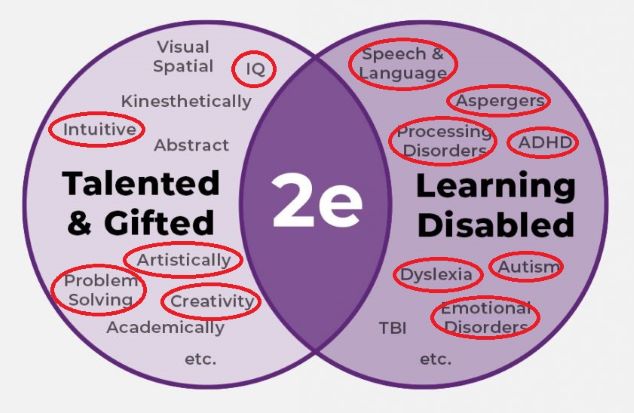
- I am twice exceptional (2e)
- I am a Highly Sensitive Person. (HSP)
- I am a Highly Intuitive Person. (HIP)
- I am Neurodivergent. (ND)

- I have Dyscalculia.
- I have auditory processing disorder (APD)
- I have autism spectrum disorder. (ASD)
- I have obsessive compulsive disorder. (OCD)
- I have developmental coordination disorder. (DCD)
- I have attachment disorders. (AD)
Reference
Alexithymia is a subclinical phenomenon involving a lack of emotional awareness or, more specifically, difficulty in identifying and describing feelings and in distinguishing feelings from the bodily sensations of emotional arousal.
ADHD is one of the most common neurodevelopmental disorders of childhood. It is usually first diagnosed in childhood and often lasts into adulthood. Children with ADHD may have trouble paying attention, controlling impulsive behaviors (may act without thinking about what the result will be), or be overly active.
- Post-Traumatic Stress Disorder (PTSD) is a mental health condition that can develop after a person experiences a traumatic event, leading to symptoms like flashbacks, nightmares, and severe anxiety.
Gifted individuals are those who demonstrate outstanding levels of aptitude (defined as an exceptional ability to reason and learn) or competence (documented performance or achievement in top 10% or rarer) in one or more domains. Giftedness and genius are neurodivergent disorders, just as any other form of neurodivergence is. A “disorder” in psychospeak is a trait or set of traits a couple of standard deviations from the norm. Autism and ADHD are two such “disorders”. So are being “gifted” or being a genius.
Bipolar II Disorder: mood swings that go from high to low, but the highs are less extreme and are called hypomanic states.
Dyslexia is a learning disorder that involves difficulty reading due to problems identifying speech sounds and learning how they relate to letters and words (decoding). Also called a reading disability, dyslexia is a result of individual differences in areas of the brain that process language.
The term twice exceptional, often abbreviated as 2e, entered educators’ lexicons in the mid-1990s and refers to gifted students who have some form of disability. These students are considered exceptional both because of their giftedness and because they are disabled.
A highly sensitive person (HSP) is someone who is thought to have an increased or deeper central nervous system sensitivity to physical, emotional, or social stimuli.
Highly intuitive people are often empaths. They experience a lot of empathy because they are able to imagine what an experience is like for someone else. They do not necessarily project their own experiences when they do this. It is a selfless insight of desire to help someone else.
The term “neurodivergent” describes people whose brain differences affect how their brain works. That means they have different strengths and challenges from people whose brains don’t have those differences. The possible differences include medical disorders, learning disabilities and other conditions.
Dyscalculia is a math learning disability that impairs an individual’s ability to learn number-related concepts, perform accurate math calculations, reason and problem solve, and perform other basic math skills. Dyscalculia is sometimes called “number dyslexia” or “math dyslexia.”
People with auditory processing disorder (APD) have a hard time hearing small sound differences in words. Someone says, “Please raise your hand,” and you hear something like “Please haze your plan.” You tell your child, “Look at the cows over there,” and they may hear, “Look at the clown on the chair.”
Autism spectrum disorder (ASD) is a developmental disability caused by differences in the brain. People with ASD often have problems with social communication and interaction, and restricted or repetitive behaviors or interests. People with ASD may also have different ways of learning, moving, or paying attention.
Obsessive-compulsive disorder is characterized by unreasonable thoughts and fears (obsessions) that lead to compulsive behaviors. OCD often centers on themes such as a fear of germs or the need to arrange objects in a specific manner. Symptoms usually begin gradually and vary throughout life.
Developmental coordination disorder may occur alone or with other developmental disorders, such as attention-deficit/hyperactivity disorder (ADHD). It usually continues into adulthood.
Attachment Disorders are psychiatric illnesses that can develop in young children who have problems in emotional attachments to others. Parents, caregivers, or physicians may notice that a child has problems with emotional attachment as early as their first birthday.
Emotional intelligence (otherwise known as emotional quotient or EQ) is the ability to understand, use, and manage your own emotions in positive ways to relieve stress, communicate effectively, empathize with others, overcome challenges and defuse conflict.
An Intelligence Quotient, or IQ, is a measure of what psychologists call our “fluid and crystallized intelligence.” Put simply, an IQ test measures your reasoning and problem-solving abilities.
 Soul Under Construction
Pingback: A Musical Blog – Soul Under Construction